
The Mortality Arbitrage
Longevity research, IP-NFTs, tokenised autophagy, and the curious case of making money by not dying.

Starting with a story about how venture capital actually works.
Last month, pharmaceutical giant Chugai (a Roche subsidiary) announced a joint research deal with Gero, an AI platform for aging research, potentially worth up to $250 million. Industry publications called it a validation of the longevity field's growing credibility with big pharma. What they didn't mention is that Gero's early development was funded by a decentralised autonomous organisation run by people who vote with cryptocurrency tokens.
VitaDAO is what happens when you take the basic insight that venture capital is just pooled money plus expert judgment, then ask: what if we made the pooling part permissionless and the expert judgment part transparent?
The result is an organisation that has funded 24 longevity research projects with $4.2 million while maintaining a $6 million treasury, attracted investment from Pfizer Ventures, and created what might be the first working model for tokenised intellectual property in biomedical research. They've done this using a combination of blockchain governance tokens, NFTs that represent legal ownership of patents, and a community of 10,000 members who vote on which anti-aging research to fund.

VitaDAO figured out how to turn venture capital into a massively multiplayer online game, and it's working better than anyone expected.
Traditional venture capital works like this: a small group of partners pools money from limited partners, uses their expertise and networks to identify promising startups, writes checks, takes equity stakes, and hopes some of those bets pay off big enough to cover the losses. The system works, but it's exclusive by design. You need millions of dollars to play, and you need connections to access the best deals.
VitaDAO starts with a different premise: what if the "expert judgment" part could be crowdsourced, and what if the "pooled money" part could include anyone with $20 to spare?
How to Turn Research Into Tokens
The actual mechanics of VitaDAO are more complex and clever than "buy tokens, fund science." Understanding how it works requires following the money through several layers of blockchain infrastructure that somehow manage to produce actual laboratory results.
Step 1: The Governance Layer
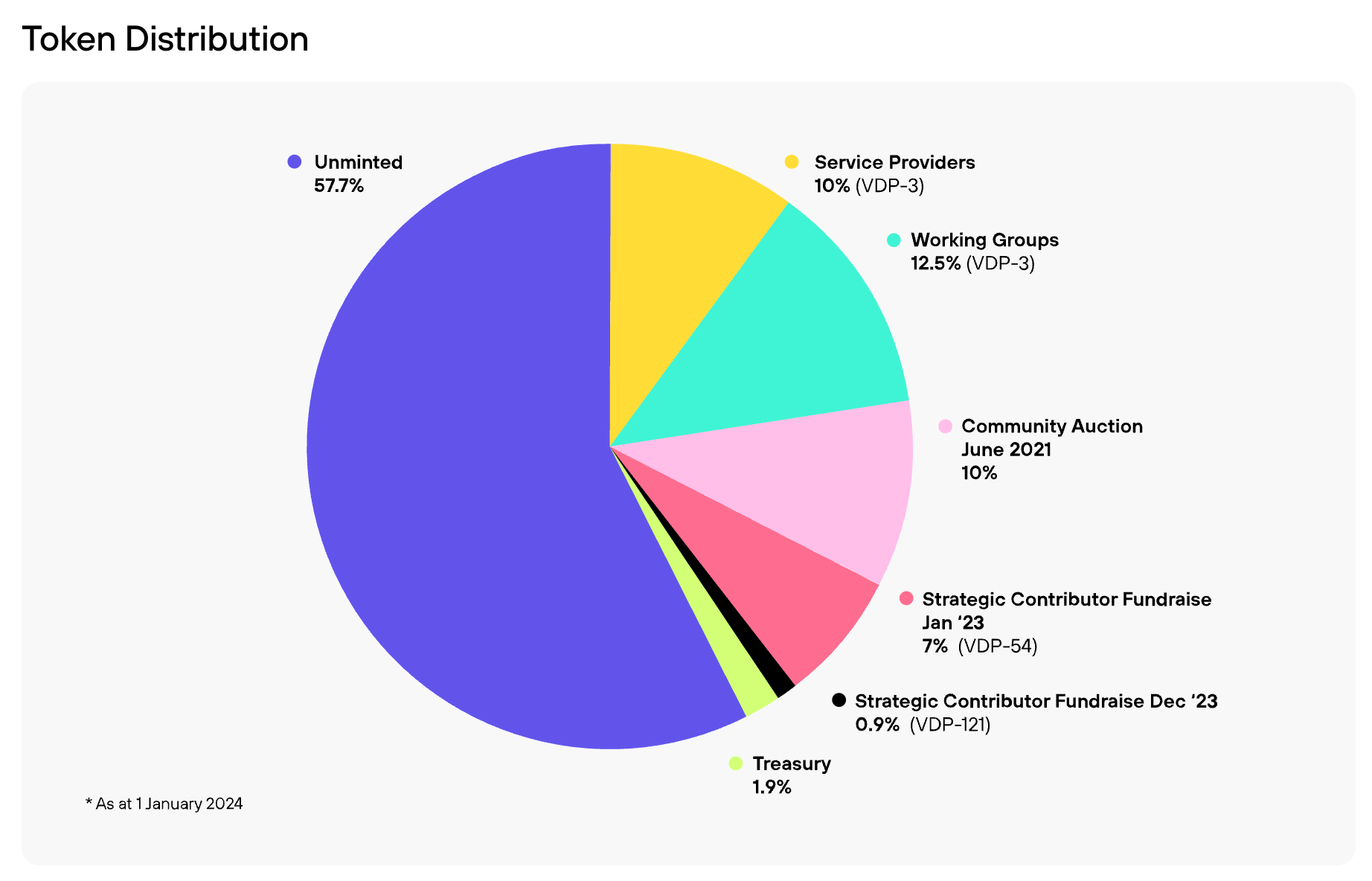
Everything starts with VITA tokens, which function as both governance rights and membership in the DAO. The total supply is capped at about 64 million tokens, with roughly 58% still unminted and held in the treasury for long-term sustainability.
You can acquire VITA tokens by contributing work to the DAO, buying them on exchanges like Uniswap, or receiving them as grants for valuable contributions.
Once you hold VITA tokens, you can vote on research proposals through platforms like Snapshot. But VitaDAO learned early that having thousands of people vote on complex scientific proposals creates chaos, so they evolved into "VitaDAO 2.0" - a hybrid model where a small group of "Guardians" (elected from top token holders) provide oversight while specialised "Pods" handle execution. There's a Longevity Pod that manages research projects and an Web3 Pod that handles tokenomics and treasury management.
Step 2: The IP-NFT Framework
When VitaDAO decides to fund a research project, they don't just send a check. Instead, they use Molecule's IP-NFT framework to create a non-fungible token that legally represents all the intellectual property rights from that research.
The process works like this: VitaDAO negotiates a sponsored research agreement with the university or lab. All the legal documents - research agreements, IP assignments, data access rights, confidentiality terms - get encrypted and wrapped into an NFT. This creates a tamper-resistant, blockchain-based record of who owns what.
The IP-NFT gets minted on Ethereum and initially belongs to VitaDAO.
Step 3: Fractionalisation Into IP Tokens (IPTs)
VitaDAO can take an IP-NFT and "tokenise" it by creating fractional ownership tokens called IPTs. These are regular ERC-20 tokens that represent governance rights and economic participation in the specific research project.
For example, the VITA-FAST project created 1 million VITA-FAST tokens backed by the Newcastle University autophagy research. Token holders get to vote on research directions, and if the research leads to commercial products or licensing deals, they share in the revenues. The tokens trade on decentralised exchanges, so their price fluctuates based on the perceived progress and commercial potential of the underlying research.
Step 4: Community Governance of Individual Projects
Each tokenised project essentially becomes its own mini-DAO. VITA-FAST token holders can vote on whether to license the research to pharmaceutical companies, fund follow-up studies, or pivot research directions. This creates a direct feedback loop between the people funding the research and the researchers doing the work.
The economic incentives align in interesting ways: researchers want their work to succeed and be commercialised, token holders want returns on their investment, and both groups benefit from transparency and community involvement rather than traditional closed-door negotiations.
Step 5: The Revenue Loop
When successful research gets licensed or spun out into companies, the revenues flow back to IPT holders according to predefined smart contracts. But VitaDAO also captures value through trading fees on the tokens and appreciation of their own holdings. They've reported that VITA-FAST generated over $130,000 in trading fees while recouping substantial portions of the original investment.
This creates a sustainable funding model where successful projects generate capital for new research, rather than profits disappearing into traditional corporate structures.
Why Pfizer Bought Governance Tokens
The most telling validation of VitaDAO's model came in 2023, when Pfizer Ventures participated in a $4.1 million funding round. Pfizer actually holds VITA governance tokens, making it the first major pharmaceutical company to directly participate in DAO governance.
Think about what this means. Pfizer has internal venture arms, corporate development teams, and research partnerships with universities around the world. They have every traditional mechanism for identifying and funding promising research. Yet they chose to participate in a blockchain-based governance system where their investment decisions are subject to community voting alongside thousands of individual token holders.
From Pfizer's perspective, VitaDAO offers something their traditional channels don't. Early visibility into research that might not otherwise reach their attention, and the ability to observe how community-driven evaluation performs compared to traditional expert networks.
For VitaDAO, having Pfizer as a participant provides credibility and industry expertise that helps validate their model to other potential partners.
The technical innovation that makes this all possible is the IP-NFT framework, developed by VitaDAO's partner Molecule. IP-NFTs solve a real problem in research commercialisation. How do you create liquid, tradeable assets out of intellectual property that exists primarily as legal agreements and research data?
Traditional IP licensing involves complex negotiations between universities, tech transfer offices, and commercial partners. Each deal is bespoke, illiquid, and opaque. IP-NFTs standardise this process by wrapping all the legal agreements, research data, and ownership rights into a blockchain token that can be programmatically controlled and traded.
The blockchain component provides transparent ownership records, programmable governance rights, and composable financial instruments that can be built on top of the underlying IP. When VitaDAO creates IPTs from IP-NFTs, they're essentially creating synthetic equity markets for individual research projects.
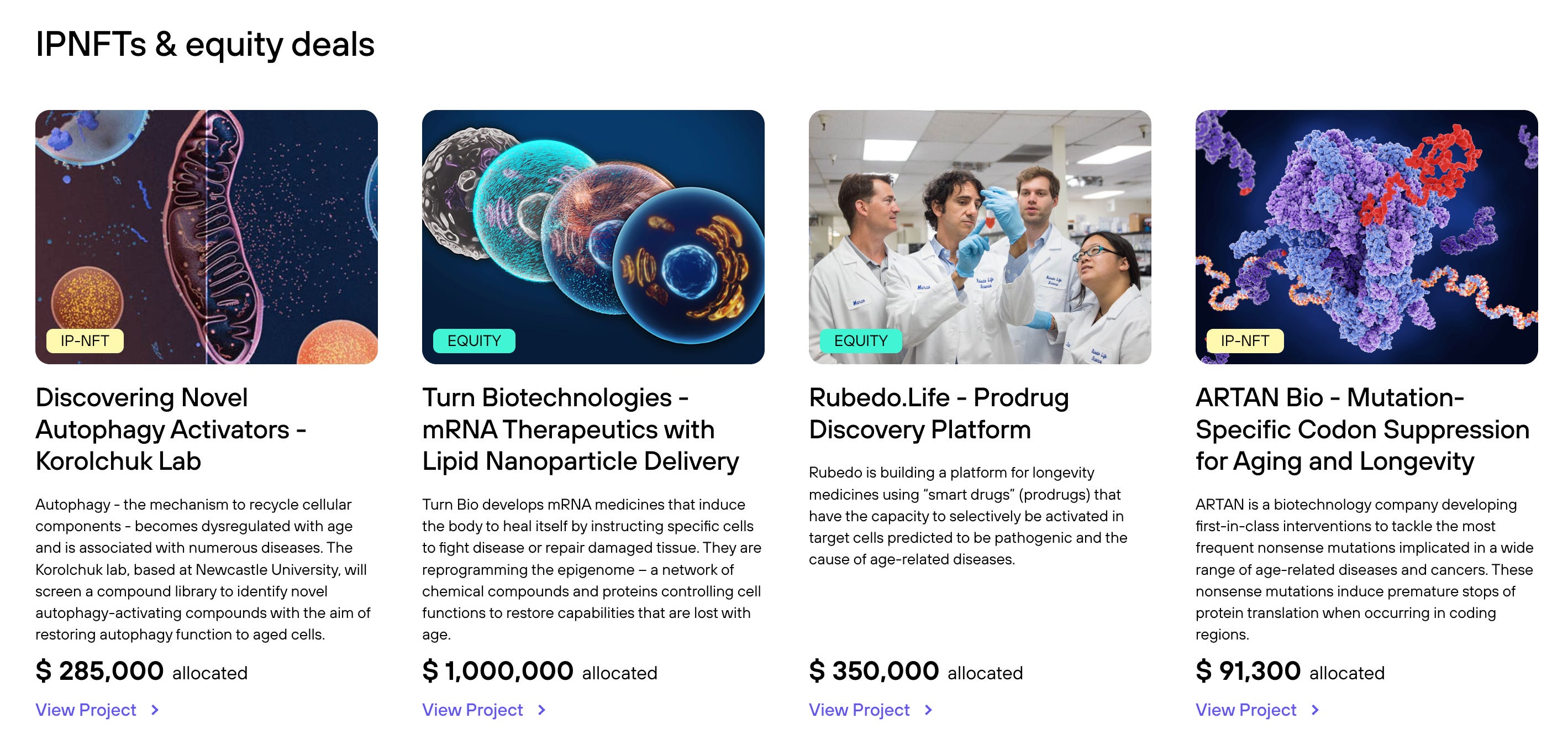
The practical result is that researchers can access capital markets directly, without waiting for traditional venture funds or pharmaceutical companies to show interest. And investors can make targeted bets on specific research directions rather than having to invest in entire biotech companies or diversified funds.
The strangest part of this story might be the role of memecoins. VitaDAO's partner platform, Pump.science, allows people to create tokens for specific longevity compounds and fund research through trading activity. Their first compound, Urolithin A, was researched and tested using funds generated by people buying and trading URO tokens.
This is venture capital through Pump.fun mechanics. People buy tokens representing anti-aging compounds, trading activity generates fees that fund animal studies, and successful compounds get turned into actual products that token holders can purchase and help test.
It sounds absurd, but it's working. Pump.science has generated over $2 billion in trading volume and funded research that led to actual supplements now available for purchase. Token holders can track their biomarkers and contribute to human studies using Apple Watch data.
The platform essentially gamified biotech research, turning the same speculative energy that drives memecoin trading into funding for legitimate scientific studies. It's a perfect example of how VitaDAO and related projects are finding ways to channel crypto speculation toward productive ends.
What Could Go Wrong
Every innovative financial structure eventually faces the question: what happens when it stops working? For VitaDAO, there are several potential failure modes worth considering.
The most obvious risk is scientific failure. Longevity research is inherently high-risk, and most early-stage projects will fail to produce commercially viable results. VitaDAO's token-based model doesn't change the underlying biology or the lengthy timelines required for drug development.
There's also governance risk. As VitaDAO grows larger and handles more complex decisions, the challenges of coordinating thousands of token holders could become unmanageable. The organisation has already evolved from pure token-weighted voting to a hybrid model with expert advisory groups and specialised working groups (called "Pods") that handle day-to-day operations.
Regulatory uncertainty presents another challenge. Tokenised IP ownership exists in a legal gray area, and securities regulators could decide that IPTs constitute unregistered securities offerings. VitaDAO has tried to structure its tokens as governance rights rather than investment contracts, but the distinction may not hold up under regulatory scrutiny.
The success of VITA-FAST and other IPTs depends partly on trading activity and token appreciation, which could prove unsustainable if crypto markets turn bearish or if the novelty of tokenised research wears off.
But zoom out, and VitaDAO represents something more significant than just another crypto experiment. It's a working example of how blockchain technology can create new market structures for funding public goods.
Longevity research faces a classic market failure: the benefits of successful aging interventions would be enormous for society, but the timeline and uncertainty make them unattractive for traditional venture capital. Academic funding is limited and risk-averse. Pharmaceutical companies focus on diseases rather than aging itself.
VitaDAO's model offers a potential solution by aggregating small contributions from many people who care about the outcome, providing liquid markets for research investments, and creating sustainable funding cycles through token economics.
The organisation has already spawned similar DAOs focused on women's health (AthenaDAO), cryonics (CryoDAO), and synthetic biology (ValleyDAO). A broader "Bio Protocol" ecosystem is emerging that provides shared infrastructure for tokenised biomedical research.
If this model scales, it could fundamentally change how early-stage research gets funded. Instead of relying on a small number of institutional gatekeepers, researchers could access global capital markets directly.
Instead of binary success/failure outcomes, research projects could generate ongoing value through IP licensing, data sharing, and token economics.
Curious about decentralised science? VitaDAO's Discord community includes researchers, crypto enthusiasts, and people who just really don't want to die.
Join the conversation, but remember: this is early-stage biotech wrapped in experimental token economics.
Do your own research, literally.